

The Village Where
Living Past 100
Is Not Unusual
Molochio, a hillside village in the Aspromonte mountains of Southern Italy, has been featured in National Geographic, studied by USC longevity scientist Dr. Valter Longo, and documented as one of the most remarkable longevity concentrations in the world. This is where Deliba olive oil is made.

A village of 2,000 people. Four centenarians. One very old olive grove.
Molochio sits at approximately 450 meters above sea level in the Aspromonte National Park — a UNESCO Global Geopark — on the Tyrrhenian side of the Calabrian mountains. The village has a population of roughly 2,000. In 2013, it had four centenarians living simultaneously, a concentration that National Geographic described as extraordinary and that drew scientists from the University of Southern California and the University of Calabria to study.
Molochio is not a Blue Zone in the official Dan Buettner classification — the five formal Blue Zones are Okinawa (Japan), Sardinia (Italy), Nicoya (Costa Rica), Icaria (Greece), and Loma Linda (California). But Forbes, USC researchers, and Italian regional authorities now informally list Molochio as Italy's own longevity hotspot, with a centenarian prevalence that Valter Longo's research found to be four times that of Okinawa.
The Cosmano family has farmed olive trees in Molochio since 1967. The same hills. The same varieties — Ottobratica, the ancient native cultivar whose name means "the one that belongs to October." The same harvest tradition. What the science is now trying to quantify, the village has been practicing for centuries.
"Molochio had four centenarians among 2,000 people — and four nonagenarians. The village's elders credited a diet of figs, beans, and olive oil."
Stephen S. Hall

What scientists found when they came to Molochio
Over the past decade, Molochio has attracted more peer-reviewed attention per square kilometer than almost any other village in Italy. Here is what the research has documented.
18-year study linking low-protein, plant-based diets to significantly lower mortality in midlife. Molochio centenarians' dietary patterns — high legume, vegetable, and olive oil intake — were a primary reference dataset.
Landmark feature profiling Molochio's four simultaneous centenarians among 2,000 residents. Introduced Dr. Passarino and Dr. Berardelli's longevity research to a global readership. 106-year-old Salvatore Caruso cited "figs, beans, and olive oil, hardly any red meat."
Randomized "Longevity Diet" trial in Molochio and Varapodio. Approximately 200 residents enrolled for 18 months following a low-protein, plant-rich protocol. Early results: improved energy, sleep, and metabolic markers. Ongoing.
Dr. Valter Longo — director of the USC Longevity Institute — has described Molochio as the place where "the mystery was in the little town where I spent my childhood summers." His book The Longevity Diet, published in multiple languages, uses Molochio's centenarians as a primary case study for his fasting-mimicking protocol.
In 2014, Salvatore Caruso — a resident of Molochio — became the oldest man in Italy at 108. He was one of four centenarians in a village of 2,000. The Italian regional government subsequently branded Molochio as Borgo della Longevità — the Longevity Village.
A 2025 genetic study by Napolioni et al. conducted a genome-wide association study of 705 Calabrians including Molochio centenarians. The research identified 267 genetic variants linked to longevity, with pathways related to protein degradation, DNA repair, and insulin signaling. Notably, common longevity genes found in other populations showed no effect in this isolated community — suggesting that Molochio's longevity is driven more by lifestyle and diet than by genetics alone.
— USC / University of Calabria research summary

Why this specific geography produces exceptional olive oil
The science of longevity and the science of polyphenols converge in the same place: the Aspromonte microclimate that has defined this land for centuries.
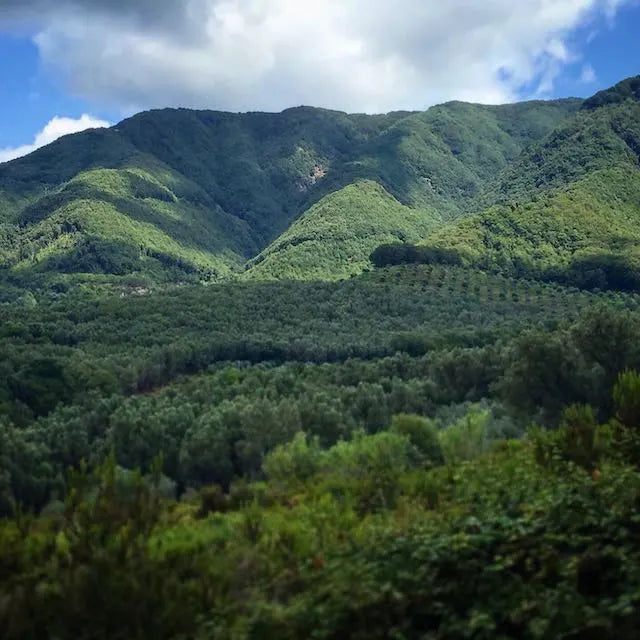
The Cosmano estate sits at 450 meters above sea level — high enough for cool nights and chronic mild water stress during the summer months. Water-stressed olive trees respond by synthesizing higher concentrations of polyphenols, the compounds that give the oil its biological activity and its characteristic peppery finish.
The soil is mineral-rich, mineral-rich, with low nitrogen content that slows tree growth and concentrates phenolic compounds in the fruit. Combined with the Aspromonte's natural wind patterns and the moderating influence of the Tyrrhenian Sea, the microclimate creates conditions that are essentially impossible to replicate at industrial scale.
The primary cultivar — Ottobratica — is indigenous to the province of Reggio Calabria and harvested in October, earlier than most Italian varieties. Early harvest at the veraison stage (green to purple transition) captures polyphenol content at its peak before the natural degradation of full ripeness. The 2025/26 batch pressed by the Cosmano family returned 629 mg/kg total polyphenols — independently certified.
The oil is cold-pressed within 4 hours of harvest on the estate itself. Transport time to a mill is the most common source of polyphenol loss in commercial production. Here, there is no transport time.
Ottobratico 2025/26
Cosmano estate
both varieties
oldest trees
How people in Molochio actually use olive oil
The dietary pattern documented by researchers is not a protocol. It is a way of life that has not changed significantly across generations. Olive oil is not an ingredient — it is the primary fat, used generously, daily, in every form.
Raw, not cooked
The traditional use is finishing, not frying. Olive oil is drizzled over legumes, vegetables, bread, and soups — raw, at room temperature, after cooking. This preserves the heat-sensitive phenolic compounds, particularly oleocanthal, that are destroyed at high temperatures. Molochio residents historically used animal fat (lard) for cooking and reserved olive oil for raw application — exactly the pattern that maximizes its anti-inflammatory properties.
Quantity matters
Longo's research documents that centenarian-density populations in this region consumed olive oil as a primary caloric source — not a condiment. Three to four tablespoons per day is consistent with what the research describes. At 629 mg/kg polyphenol concentration, a single tablespoon of Deliba Ottobratico delivers approximately 9 mg of polyphenols — a meaningful dose by any clinical standard.
Paired with legumes
The dietary pattern consistently documented in Molochio is olive oil with legumes — specifically fava beans, chickpeas, and lentils. The combination provides plant protein, fiber, and the phenolic compounds of the oil. Salvatore Caruso, who became Italy's oldest man at 108, described his daily diet as "figs, beans, and olive oil." No supplements. No protocols. Just the food.
The taste of oleocanthal
High-polyphenol oil has a flavor that is unmistakable — a peppery burn at the back of the throat caused by oleocanthal, a phenolic compound that acts as a natural COX inhibitor with a mechanism similar to ibuprofen. In Molochio, locals describe this sensation as a sign of good oil. The more intense the pepper, the higher the oleocanthal. The Cosmano estate's Ottobratico tests at 312 mg/kg oleocanthal — among the highest documented for this cultivar.

Growing up where centenarians are the norm
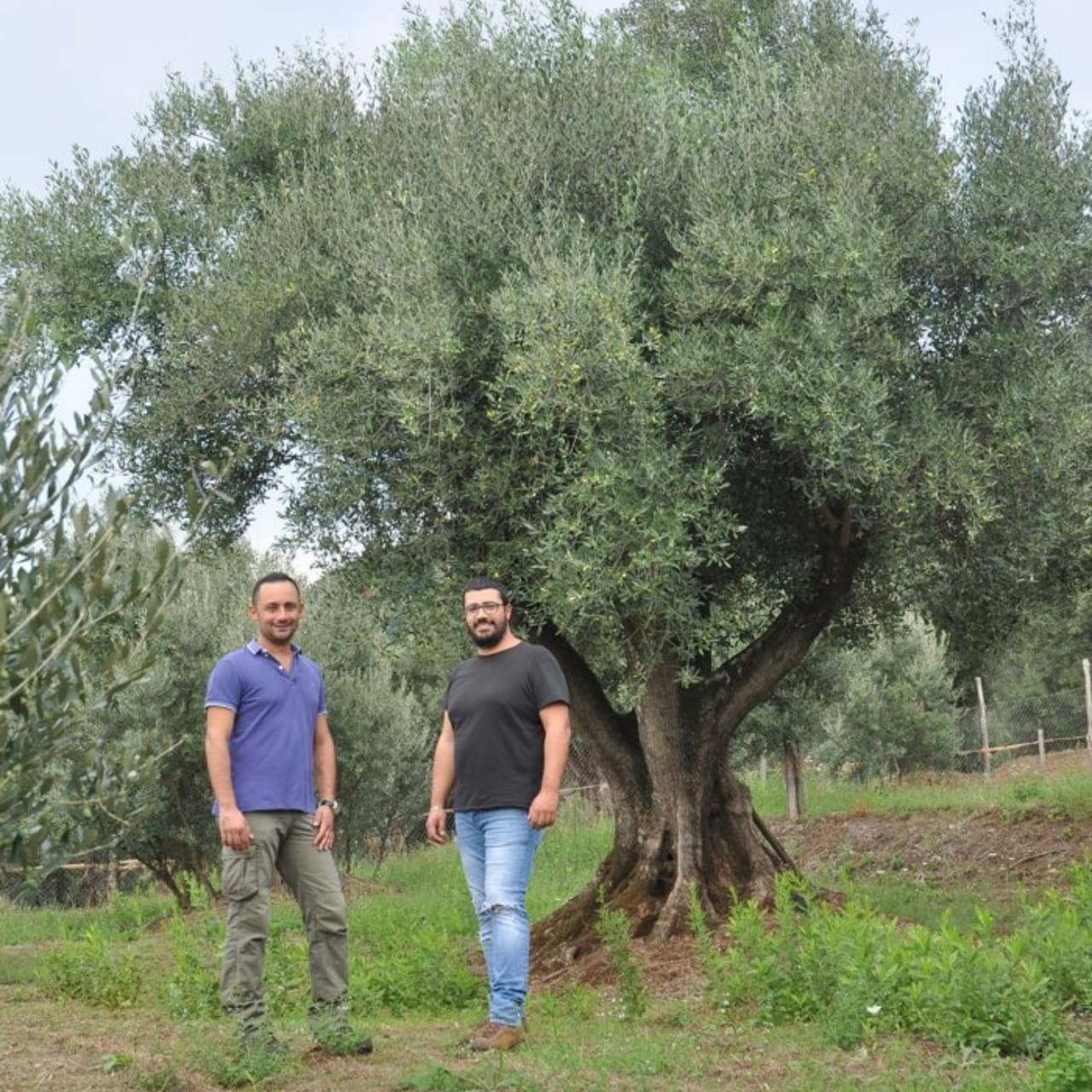
Gianfranco Cosmano grew up in Molochio. Not as a tourist destination. Not as a research subject. As a village where knowing someone over 100 was not remarkable — it was ordinary. The neighbors, the relatives, the people at the market. Old age was not feared here. It was expected.
The Cosmano family has farmed olives in Molochio since 1967, when Gianfranco's father Francesco began cultivating what would become a 96-acre estate of Ottobratica and Sinopolese trees. Some of these trees predate the family's ownership by centuries — possibly by a millennium.
Gianfranco founded Deliba Food Inc. in New York to bring this oil directly to the U.S. market — not through distributors, not through importers, but personally. The supply chain is two entities: the family farm in Molochio and Deliba Food Inc. in the U.S. Nothing in between.
The lab data, the harvest date, the single-origin traceability — these are not marketing choices. They are the natural result of knowing exactly where the oil comes from, because it comes from the same land where your family has lived for generations.
Frequently Asked Questions
Bring Molochio
to Your Table
The 2025/26 harvest from Molochio is in bottles now. 629 mg/kg polyphenols. Independently certified. Harvest-dated October 2025. Pressed within 4 hours on the Cosmano family estate — the same land documented by National Geographic and studied by Valter Longo.