

Italian Producer · Practical Guide

How to Use EVOO:
Smoke Point, Cooking,
Storage & Daily Dose

EVOO smoke point sits between 375–410°F (190–210°C) — safe for sautéing, roasting, and pan-frying. This guide covers every use case: cooking, finishing, drizzling, storage, and how much to use daily, from a producer who presses 629 mg/kg polyphenol EVOO in Molochio, Southern Italy.
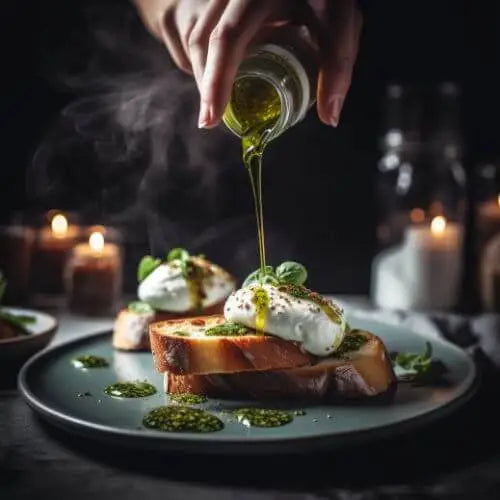
Cooking with Deliba extra virgin olive oil — sautéing in a pan with Italian EVOO
EVOO — What It Means in the Kitchen

EVOO stands for extra virgin olive oil — the highest grade of olive oil, cold-pressed without heat or chemical solvents. It retains the full natural flavor, aroma, and polyphenol content of the olive. In a recipe, "EVOO" always means the same thing: unrefined, first cold press, acidity ≤0.8% free oleic acid.

In practical kitchen terms, EVOO works for four distinct uses: cooking (heat applied), finishing and drizzling (added off-heat as a final touch), pairing (used raw as a dip or condiment), and daily dosing (a measured intake for health purposes). Each use has a different logic — this guide covers all four, plus how to store EVOO correctly to preserve what you paid for.

01 — Smoke Point

EVOO Smoke Point: 375–410°F (190–210°C)

The smoke point of high-quality EVOO sits between 375–410°F (190–210°C) — well above typical sautéing and roasting temperatures. The concern that "EVOO burns and becomes toxic" is a persistent myth. Published research (Australian Oils Research Laboratory, 2018) found EVOO outperforms most refined oils in oxidative stability when heated.

What determines smoke point? The main factor is free fatty acid (FFA) content — not oil grade. A fresh, low-acidity EVOO (like Deliba at 0.15% FFA) has a higher smoke point than an older, oxidized "pure olive oil" at higher acidity. Polyphenols act as natural antioxidants that slow degradation under heat.

Rule of thumb: Home cooking — sauté, roast, pan-fry — rarely exceeds 350°F. EVOO at 375–410°F gives you a 25–60°F buffer. Deep frying (375–400°F sustained) is the one context where a higher-smoke-point refined oil makes practical sense.
Oil
Smoke Point
Best for
Pure/refined olive oil
410–465°F / 210–240°C
Deep fry · High heat
Avocado oil (refined)
520°F / 270°C
High-heat sear · Deep fry
Vegetable oil (refined)
400–450°F / 205–230°C
Deep fry · Neutral baking
Coconut oil (refined)
350–400°F / 175–205°C
Baking · Light sauté
Butter (unsalted)
300–350°F / 150–175°C
Low-heat only

Smoke point values vary by freshness, FFA content, and brand. USDA FoodData Central / published literature.
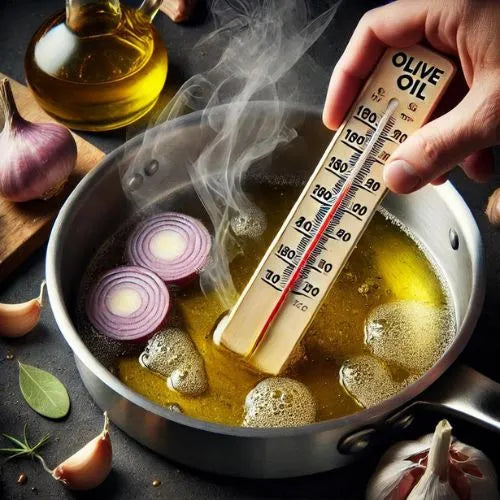
Extra virgin olive oil in a pan showing correct heat for sautéing — below the smoke point
02 — Cooking

Cooking with Extra Virgin Olive Oil

EVOO is the default cooking oil in the Italian kitchen — not a luxury saved for finishing. Sautéing onions, garlic, peppers, and zucchini; roasting fish and chicken; pan-frying cutlets. This is how Southern Italian households have cooked for centuries.
1
Sautéing vegetables
Medium heat. Add EVOO cold to the pan, let it warm before adding vegetables. Don't let it smoke — the moment it shimmers, it's ready. Onions, peppers, zucchini, eggplant, cherry tomatoes.
2
Roasting
Drizzle over vegetables or fish before putting in the oven. Bake at 375–400°F. Add a second drizzle of fresh EVOO as a finishing touch the moment it comes out. The raw drizzle on top transforms the dish.
3
Pan-frying
Shallow-fry cutlets, patties, or fish fillets. Keep heat medium-steady — no smoking. EVOO adds flavour that neutral oils cannot. Drain on paper and finish with flaky salt.
4
Eggs (the Italian way)
A generous pour of EVOO in a cold pan, medium heat. Once shimmering, crack the eggs in. Spoon the hot oil over the yolk. The edges go crispy and golden. Finish with salt and pepper. That's it.
Which Deliba for cooking? Sinopolese (609 mg/kg) is the everyday cooking oil — its polyphenol stability makes it well-suited to moderate cooking temperatures. Save Ottobratico (629 mg/kg) for raw finishing where its peppery intensity shines. See both oils →
Pouring Deliba extra virgin olive oil — the moment of finishing a dish
Molochio, Southern Italy · Harvest 2025 · 629 mg/kg
03 — Finishing & Drizzling

Finishing and Drizzling: The Most Important Use of High-Polyphenol EVOO

Finishing — adding EVOO raw, off-heat, as the final touch before serving — is where high-polyphenol oil makes the biggest difference. Heat degrades polyphenols. A raw drizzle delivers the full 629 mg/kg, the peppery throat finish (oleocanthal at 312 mg/kg), and the fresh aroma that disappears with cooking.

Finishing vs drizzling: one distinction worth making. Finishing means adding oil to a hot dish immediately off the heat — soups, pasta, grilled fish — where the residual warmth opens up the aroma without degrading it. Drizzling is the lighter hand applied to cold dishes, raw preparations, or plated food at room temperature: salads, bruschetta, cheese, sliced tomatoes. Both are raw uses. Both preserve the full polyphenol content. The technique and pour volume differ.

This is also the most efficient path to the EFSA health claim threshold: 20g daily of raw high-polyphenol EVOO. One generous drizzle at the end of lunch and dinner covers it.
20g
Daily for EFSA claim
629
mg/kg polyphenols
312
mg/kg oleocanthal
raw
Maximum benefit
1
Salads & bowls
Toss with a squeeze of lemon, flaky salt, and a generous pour of EVOO. No emulsification needed — the oil, acid, and salt work as dressing directly on the greens.
2
Soups & stews
Finish each individual bowl with a teaspoon of EVOO just before serving. The heat of the soup warms the oil without degrading it significantly. Adds depth and aroma to every spoonful.
3
Pasta & grains
Drain the pasta, swirl in raw EVOO off the heat, toss. The carbohydrate surface absorbs the oil completely. A tablespoon per person is the Italian standard.
4
Grilled fish & meat
A drizzle on grilled fish or chicken the moment it comes off the grill — while still very hot — is the simplest way to elevate a dish. Salt, lemon, EVOO. Nothing else needed.
Finishing with Deliba extra virgin olive oil — drizzle on bread for dipping
04 — Pairing

Pairing: Bread, Cheese & Vegetables

Used raw as a dip or condiment, EVOO is a standalone food experience — not a background ingredient. A Calabrian producer's table: rustic bread, a small dish of EVOO with flaky salt, fresh or aged cheese, charred vegetables. This is the simplest way to taste what 629 mg/kg actually means on the palate.

Deliba olive oil paired with bread and Mediterranean produce from the Molochio farm
🍞
Rustic Bread
Warm or toasted slices. A small dish with EVOO and flaky sea salt. Dip — don't spread. The bread soaks up the oil and the salt amplifies the polyphenol bitterness into something complex and satisfying.
🧀
Fresh & Aged Cheese
Drizzle on ricotta, burrata, or fresh mozzarella — the fat-on-fat combination is incomparably rich. On aged pecorino or parmigiano, the peppery EVOO cuts through the salt and intensity.
🫑
Grilled Vegetables
Charred peppers, eggplant, asparagus, zucchini. Drizzle with EVOO and a squeeze of lemon the moment they come off the grill. The smoke from the char and the pepper of the oleocanthal are made for each other.
🥗
Antipasti & Spreads
Hummus, baba ganoush, roasted chickpeas, white bean puree. Finish with EVOO on top, never mixed in. The contrast between the smooth spread and the raw oil adds texture and depth to each bite.
🍋
Quick Dressing
2 tbsp EVOO + 1 tbsp lemon juice + pinch sea salt + fresh herbs. No blender needed. Shake in a jar or whisk in a bowl. Works on salads, fish, grains, roasted vegetables — everything.
🫙
Dip for Entertaining
Pour EVOO into a shallow dish. Add dried oregano, flaky salt, and a small sprig of rosemary. Serve with a good crusty bread. The simplest antipasto — takes 30 seconds to prepare and always impresses.
05 — Storage

How to Store Olive Oil to Protect the Polyphenols

EVOO is a fresh-pressed fruit juice. The same conditions that degrade fresh produce — light, heat, oxygen, time — degrade olive oil. The difference is that degradation in olive oil is invisible: the oil looks identical when it's fresh at 629 mg/kg and when it's dropped to half that value six months later. The only way to know is a lab test or to taste carefully.

The three enemies of EVOO are light, heat, and air. Each one accelerates oxidation — the chemical process that breaks down polyphenols and turns fresh, peppery oil into something flat, oily, and eventually rancid. If you paid for 629 mg/kg, storage is the only way to still be getting 629 mg/kg at the table. For a deeper dive into containers, formats, and shelf life, see the complete EVOO storage guide →

🫙
Dark glass or tin
The correct container for EVOO. Dark glass (Deliba uses dark green 500ml bottles) blocks UV and visible light that accelerates oxidation. Tin is equally effective. Clear glass is the worst option — it offers zero light protection.
🌡️
Cool, stable temperature
Store between 57–70°F (14–21°C). A kitchen cupboard away from the stove is ideal. The refrigerator is acceptable but unnecessary — cold makes EVOO temporarily cloudy and thickens it. This is harmless and reversible at room temperature.
🔒
Cap sealed when not in use
Oxygen exposure starts the moment you open the bottle. Seal it immediately after pouring. Do not leave olive oil in an open pourer on the counter. A tight-fitting pourspout that can be closed is fine. A wide-open cruet left out is not.
🚫
Not next to the stove
The most common mistake. Heat from the stove, oven, or direct sunlight through a window accelerates oxidation dramatically. A bottle stored at 80°F degrades several times faster than one kept at 65°F. Move it away from heat sources.
☀️
Not on the windowsill
Natural light is EVOO's fastest enemy. Even indirect daylight through a window causes measurable polyphenol loss within days. A windowsill display might look appealing — it ruins the oil. Store in a cupboard or pantry, always.
📅
Consume within 12–18 months
The harvest date tells you when to start the clock — not the best-before date. Deliba Ottobratico 2025/26 was pressed in October 2025. Peak quality is within the first 12 months. The oil is still safe after 18 months, but polyphenol content will have declined.
The harvest date is your freshness guarantee. A best-before date of 2027 on a bottle produced in 2024 tells you nothing useful. The harvest date — October 2025 on every Deliba bottle — is the only number that tells you how fresh the oil actually is. Why harvest date matters →
06 — Daily Dose

How Much EVOO Per Day: The Evidence-Based Answer

The EFSA-authorized health claim for olive oil polyphenols is based on consuming 20g daily — approximately 1.5 tablespoons — of a qualifying high-polyphenol EVOO (minimum 250 mg/kg polyphenols). This threshold is the minimum required to trigger the documented effect on LDL oxidation protection. Deliba Ottobratico at 629 mg/kg exceeds that threshold by a factor of 2.5.

The most important detail: the 20g should be consumed raw — as a finishing drizzle or in a salad dressing — not exclusively through cooking. Heat reduces polyphenol availability. Cooked EVOO still contributes, but the EFSA claim is specifically calibrated around raw consumption.

In practice, reaching 20g daily is straightforward if EVOO is part of your normal cooking routine. The approach used in Southern Italian households — and by the centenarians of Molochio — is not measured doses. It's EVOO as the default fat at every meal: cooking, finishing, and dipping. The dose takes care of itself. For the science behind polyphenols and health, see the nutrition and health benefits guide →

EFSA minimum daily dose
20g
≈ 1.5 tablespoons. The threshold for the authorized health claim on LDL oxidation protection. Your EVOO must be ≥250 mg/kg polyphenols.
Ottobratico polyphenols
629 mg/kg
2.5× above the EFSA qualifying threshold. 20g of Ottobratico delivers approximately 12.6mg of polyphenols per serving.
Practical daily split
1 + 1 tbsp
One tablespoon for cooking at lunch, one tablespoon raw as a finishing drizzle at dinner. Distributed intake is better than a single dose.
Caloric note
~120 kcal
Per tablespoon. EVOO is calorie-dense. 20g daily (1.5 tbsp) adds approximately 180 calories — account for this within your overall diet.
The Molochio approach: The centenarians of Molochio, Southern Italy — a village with 5× Italy's average centenarian rate — do not measure doses. EVOO is present at every meal, as a cooking fat, a finishing drizzle, and a dip. The habit is the dose. The longevity connection →
Pouring Deliba extra virgin olive oil daily — the recommended 20g dose for EFSA health claim
EVOO versus vegetable oil for cooking — comparing smoke point and health profile
07 — Substitution Guide

Can You Substitute EVOO for Vegetable Oil?

Yes — in most cases, EVOO is a direct 1:1 substitute for vegetable oil in cooking and baking. The flavour profile changes (EVOO adds fruitiness and slight bitterness), but the chemistry works. Vegetable oil is refined, neutral, and stripped of all nutritional value beyond fat calories. EVOO retains polyphenols, vitamin E, and the full flavour of the olive.

Task
EVOO as sub?
Notes
Sautéing / stir-fry
✓ Yes — perfect
EVOO is better here. Adds flavour and has adequate smoke point.
Roasting vegetables
✓ Yes — preferred
EVOO caramelises better and adds sweetness under oven heat.
Pan-frying (shallow)
✓ Yes
Keep heat medium-steady. EVOO adds superior flavour.
Baking (muffins, cake)
✓ Yes — ¾:1 ratio
Use ¾ cup EVOO for every 1 cup vegetable oil. Slightly lighter crumb.
Frying chicken / deep fry
△ Use refined olive oil
Deep-frying at 375°F sustained risks exceeding EVOO smoke point. Refined OO is better.
Neutral-flavour baking
△ Taste difference
EVOO adds its own flavour. In delicate cakes that want zero oil taste, use refined oil.
Italian cooking answer: There is no vegetable oil in the Southern Italian kitchen. EVOO has always been the only cooking fat — for frying, roasting, and dressing. The question only arises in countries where industrial seed oils became the default. Switch to EVOO for everything except sustained deep frying.
08 — Daily Habits

Everyday Hacks to Use More EVOO

The EFSA-authorized health benefit requires 20g daily (about 1.5 tablespoons) of a qualifying high-polyphenol EVOO. The easiest way to reach it: build EVOO into your default routine rather than treating it as an occasional condiment.

Replace butter on toast — pour EVOO directly, add flaky salt. Takes less time than buttering and tastes better.
Finish every soup and pasta — one teaspoon per bowl, always off the heat. Raw EVOO on a hot dish warms without degrading polyphenols.
Morning tablespoon — some longevity enthusiasts take it straight. The peppery burn (oleocanthal) tells you the polyphenol content is real. A mild oil is an empty oil.
Swap butter in baking — ¾ cup EVOO for every 1 cup butter. Lighter crumb, cleaner flavour, added polyphenols in your baking.
Add to smoothies — 1 tbsp EVOO in a fruit or vegetable smoothie adds creaminess and healthy fats. Polyphenols are fat-soluble — pairing them with food aids absorption.
Use a ceramic pourer at the table — having EVOO on the table rather than in the cupboard means you use it habitually at every meal. Habit over intention.
Pouring extra virgin olive oil on healthy Mediterranean food — daily EVOO habits
Free Deliba EVOO Recipe Book — 15 Mediterranean recipes

Download Our Free EVOO Recipe Book

15 easy Mediterranean recipes showing how to use extra virgin olive oil for cooking, finishing, and pairing. Get the PDF in your inbox and start cooking tonight.

09 — FAQ

Frequently Asked Questions

What is EVOO in cooking and on a menu?
EVOO stands for extra virgin olive oil. On a restaurant menu it signals that the dish uses the highest-grade olive oil — cold-pressed, unrefined, with full flavour and polyphenol content intact. In a recipe, EVOO always means first cold-press oil with acidity ≤0.8%. "Pure olive oil" or "olive oil" (no qualifier) is a lower grade, refined and blended.
What is the smoke point of extra virgin olive oil?
High-quality EVOO has a smoke point of 375–410°F (190–210°C), depending on freshness and free fatty acid content. This is sufficient for sautéing (typically 250–325°F), roasting, and pan-frying. The only scenario where EVOO's smoke point is a practical constraint is sustained deep frying at 375°F or above — where refined olive oil or avocado oil is a better choice.
Can I use EVOO as a high heat oil?
Yes — EVOO handles most high-heat home cooking. Its smoke point of 375–410°F (190–210°C) covers sautéing, roasting, and pan-frying. The key advantage over refined seed oils is oxidative stability: the polyphenols in high-quality EVOO act as natural antioxidants that slow degradation under heat. A 2018 study by the Australian Oils Research Laboratory found EVOO outperformed most refined oils in stability when heated, producing fewer harmful oxidation compounds. The only scenario where EVOO is not the right choice is sustained deep frying at 375°F or above. For everything else, EVOO is the correct high-heat cooking oil.
Can I fry with extra virgin olive oil instead of vegetable oil?
Yes, for shallow frying and pan-frying. EVOO's smoke point (375–410°F) handles pan-frying and sautéing without breaking down. For deep frying at sustained high heat, refined olive oil or avocado oil is a more practical choice. For everything else — sautéing onions, pan-frying fish or cutlets, roasting — EVOO is the better option: higher polyphenol content, superior flavour, and no industrial processing.
Can I sauté with extra virgin olive oil?
Yes. Sautéing typically operates at 250–325°F — well below EVOO's smoke point. Add the oil to a cold pan, warm to medium heat, then add your vegetables or protein. The moment it shimmers, it's ready. Don't preheat the pan dry and then add oil — that's how you overshoot the temperature. EVOO is the correct choice for sautéing in Mediterranean and Italian cooking.
Does cooking destroy the health benefits of EVOO?
Heat reduces polyphenol concentration but does not eliminate it at moderate temperatures. Research shows that high-polyphenol EVOO retains meaningful phenolic activity through sautéing and roasting up to approximately 180°C (356°F). For maximum polyphenol delivery, use EVOO raw as a finishing drizzle — this is where the full 629 mg/kg reaches your food intact. Daily raw use (20g) is the EFSA-referenced dose for the authorized health claim. Read the health benefits guide →
How much EVOO should I use daily?
The EFSA-authorized health claim for olive oil polyphenols is based on 20g (about 1.5 tablespoons) daily of a qualifying oil (≥250 mg/kg polyphenols). In practice: 1 tbsp for cooking at lunch, 1 tbsp raw finishing at dinner. Distribute it — cooking and finishing rather than a single dose. Olive oil is calorie-dense (~120 kcal/tbsp), so daily use should fit within your overall diet.
What is the correct way to store extra virgin olive oil?
Store EVOO in a dark, cool place — a kitchen cupboard away from the stove, at 57–70°F (14–21°C). Keep the cap sealed when not in use. Never store on a windowsill or next to the oven. The three enemies are light, heat, and air — each accelerates oxidation and polyphenol loss. Dark glass or tin containers are correct; clear glass is not. Consume within 12–18 months of the harvest date. Full storage guide →
What is the difference between finishing olive oil and cooking olive oil?
The difference is in the use, not the product — though the quality matters more for finishing. Cooking EVOO is added to a pan before heat is applied: for sautéing, roasting, pan-frying. Heat reduces some of the polyphenol content and volatilizes the lighter aromatic compounds. Finishing EVOO (also called finishing oil or drizzling oil) is added raw, off-heat, as the final step before serving: on a salad, drizzled over soup, swirled into pasta. Here, the full flavour profile — the peppery oleocanthal, the grassy fruitiness, the aroma — reaches your food intact. A high-polyphenol EVOO like Ottobratico is worth using for both, but the raw use is where the difference between a premium oil and a supermarket bottle is most obvious.
What do Italians cook with — is it always olive oil?
In Southern Italy — Calabria, Sicily, Puglia — EVOO is the only cooking fat. There is no vegetable oil, no sunflower oil as a default. Butter appears occasionally in the north. The Calabrian kitchen uses EVOO for frying, sautéing, roasting, dressing salads, and finishing everything. The question of whether to use olive oil versus vegetable oil simply doesn't arise — it's EVOO by default, always.

The EVOO That Actually Burns.
629 mg/kg. Lab-Certified.

Deliba Ottobratico 2025/26 from Molochio, Southern Italy. The peppery throat finish is oleocanthal — 312 mg/kg of it. Pressed within 4 hours of harvest. Independent lab certified.